
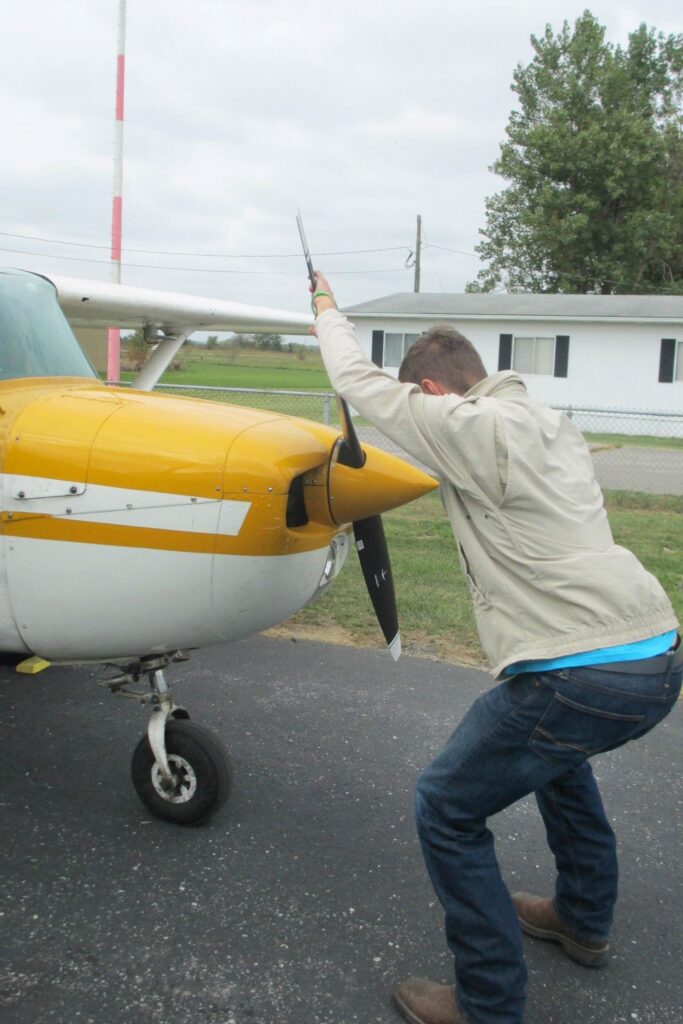
![The alternative to bending down as the propeller is pulled through the compression stroke is to keep the back straight and bend the knees slightly, stepping away in a crouch. [Credit: LeRoy Cook]](https://kitplanes.com/wp-content/uploads/2026/05/IMG_1519-683x1024.jpg)
Faced with a five-hour flight in a fleeting afternoon, the impatient airplane was sitting at the gas pump where we had towed it, full of gas and preflighted. It hadn’t been run for over two months, but as minimal-maintenance owners are always want to say, “It was running fine when we put it away.” Perhaps so, but the starter only grunted before the relay clicked into immobility. The pilot had been running lights, radio and flaps for several minutes as part of his textbook preflight prep, and had thereby drained the last dregs from the aged battery. His flight wasn’t going anywhere.
Fortunately, I was able to provide a solution, on the end of my arms. I leaned into the cockpit and coached the pilot on what we were about to attempt. I verified that the brakes were set, swung the propeller blade through a compression stroke, and the engine fired up. The ammeter verified a healthy charge rate, so the flight was back on.
Hand propping an airplane engine is not for the unwary. It shouldn’t be attempted without training and only if the propee has adequate knowledge of the likelihood of success. I was 16 when I started hanging out on the flight line sixty-some years ago, and there were a lot of airplanes without starters in those days. In addition to helping drag planes in and out of hangars, topping off fuel and cleaning windshields, we ramp rats were expected to provide “a prop” once in a while. The management held classes to show us how to do it safely and with the best chances of starting immediately. Propping was just a normal part of airport life.
Airports and airplanes have changed. Nowadays, teenagers are forbidden to work or loiter around running machinery like aircraft, leaving them little to do except play video games and plot idle mayhem. Modern airplane engines are sophisticated large-displacement, high-compression, fuel-injected powerplants, not well suited for hand-propping. Tricycle-gear planes leave the propeller hub at or below chest-height, which requires attaining an awkward bent-over stance in order to pull the prop through a compression stroke.
The ideal candidate for old-fashioned manual starting is a tailwheel airplane with a carbureted engine developing less than 100 hp from a 6.3 to 7:1 compression ratio. Trying to prop a 300-hp motor with 10:1 compression requires the strength of a lately departed Hulk Hogan. Oddly enough, old low-compression radial engines fitted with long propeller blades were relatively easy to hand-prop, despite their massive displacement.
Why Hand-Prop, And When Not To
The need to manually start an aircraft engine falls into two categories; having to do it because there’s no electrical system on the aircraft, or because the starter isn’t working. Some airplanes are purposely designed without starters, batteries and generators for simplicity and lightness, and they are predictably easy to prop. However, starting by hand because the battery is low or the starter is inoperative can encompass a variety of degrees of difficulty.
First, don’t waste your time if you find the battery completely dead unless it’s an older plane with a generator. An alternator needs a source of voltage to excite the alternator’s field, so even if you get it running it’ll never supply power. It’s necessary to put some kind of charge into the battery before attempting any kind of start. Next, if you’ve almost exhausted the battery trying to turn over a Lycoming engine, you’ve probably engaged the starter in the process and will have a very hard time spinning the prop with the added drag of the starter against the drive gear. Finally, low-mounted propellers on the front of tricycle gear airplanes will require the aforementioned crouching down to make the rotation, a dangerous position. Also, some engines have propellers indexed so that the compression stroke comes at a less than optimum position for swinging the prop by hand; ideally, you want to be able to pull the prop through from the 10 o’clock point. As you can see, there are a bunch of reasons you shouldn’t attempt to prop an unsuitable airplane/engine combination.
How To Do It
Find some help. Preferably another pilot familiar with the process. Propping an airplane by yourself involves considerable risk; I’ll have more to say about this later. Even with the assistance of a fellow pilot, make sure they know what they’re expected to do. Holding the brakes while you spin the prop is just part of their duties. They need to know how to confirm when the magnetos are to be on or off, what it means to have the throttle “cracked,” and who’s going to be in charge. I had one helper who thought it would be beneficial to twist the key to “start” when he turned the ignition on; the prop moved just as I was about to reach for the blade, fortunately not enough to start.
Communication is key. The person swinging the propeller is the one who can get hurt, so they are the boss, and they need confirmation to definitely know when the ignition is on or off. Go over the terminology with your person in the cockpit. If you call “Switch off” it means the mags are to be checked to be sure they are off, and he or she is to respond with “Switch off.” “Contact” is the traditional request for magnetos to be turned on, not “Switch on,” which could be confused with “Switch off” in a noisy environment. If I call for “Contact and brakes” I expect to hear the reply “Contact and brakes” and I’ll nudge the prop hub to assure that the brakes are holding. “Throttle cracked” is a request for positioning the throttle to full idle and then opening it slightly to assure a prompt start.
Prepare the engine for starting with an adequate amount of priming; as part of the priming, I’ll usually make sure the mags are off and the throttle is open, then turn the propeller over a few compression strokes before resetting the throttle, leaving the propeller parked just before the compression point. Without delay, call for “Contact and brakes,” listen for a confirmation, and swing the propeller blade briskly downward as you step away from what you hope will be a running engine.
Impulse coupling notwithstanding, magneto ignition systems respond best to a quick, firm “snap” as the propeller is moved through a compression stroke, simulating the rapid twist of a starter motor. Dragging the prop through slowly may not get results and is riskier for the participant.
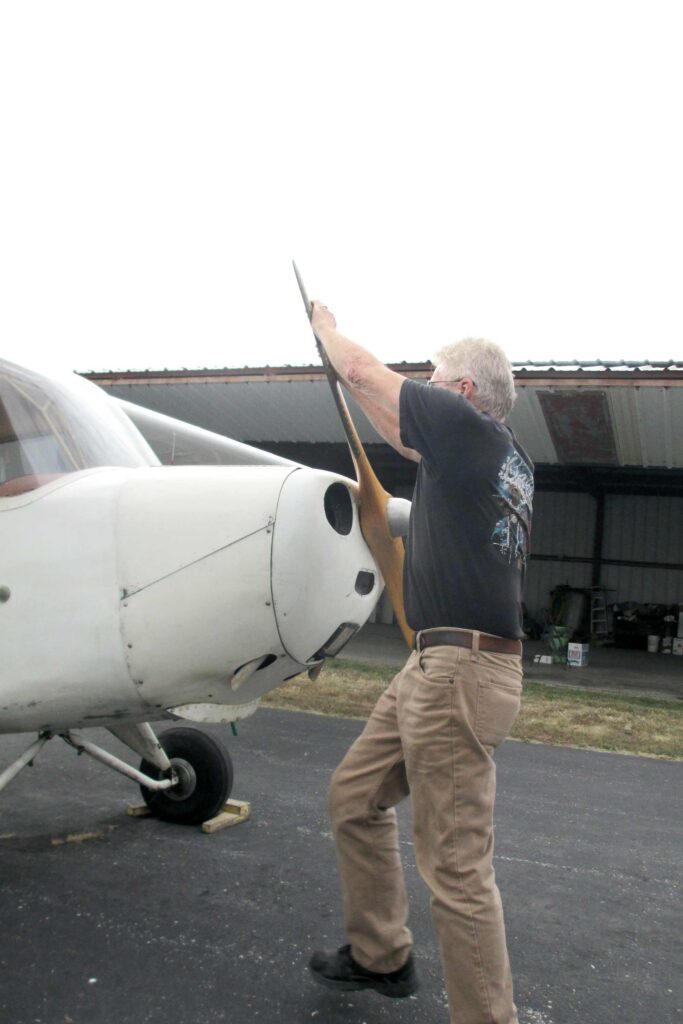
Take precautions to assure safety. Do not stand on a slippery surface as you attempt to prop an engine; you don’t want to lose footing and fall into a turning propeller. Move the airplane if necessary. If wearing a jacket, make sure it’s not flopping loosely; zip or button up so it can’t be snagged by a blade. Do not place any more of your fingertips over the propeller blade than you want to break or have cut off; one knuckle is enough to provide purchase; none would be better. Stand close to the propeller, rather than warily standing back and leaning over; if you lose balance and fall, you want to be going away from the prop disc, not into it. As you move the blade down through the compression stroke, be making a step back, giving some extra leverage and heading for safety. Use both hands, if for no other reason than to get the spare arm out of the way.
If the engine didn’t start and you want to try again, call “Still hot,” and get a reply, and repeat as necessary. If the propeller needs to be repositioned, call for “Switch off” and carefully move it back onto the compression spot, then call “Contact and brakes.” If you suspect that the engine is flooded and refusing to start, call “Switch off” and open the throttle to turn the engine over several times to clean out the cylinders, then make another attempt.
Should your efforts be rewarded with a start on the first or second pull, stand back and beam with pride. If you’re going flying, walk circuitously to a wingtip and then proceed to the cockpit; a running aircraft should only be approached from the hemisphere aft of the wingtips (pusher airplanes require the reverse.) If you’re simply aiding a departing pilot, walk away to a spot within full view and give a wave or salute, unless marshalling is warranted.
What If Nobody’s Around?
As I said, hand-propping an airplane by yourself is a dumb idea. But sometimes there’s no alternative. If you have no other choice, take all precautions to prevent a runaway. Drag the plane to the tiedowns and secure it with ropes. Set the parking brake if you wish, but don’t depend on it holding. Put chocks under both mainwheels. Tie the pilot’s yoke or stick back with a seatbelt. Turn off the fuel valve. Then carefully prime and set the ignition and throttle, hoping for a quick, gentle response when you twist the prop. Some people like to prop from behind so they can reach the throttle, as floatplane pilots have to do out of necessity, but I only do it on landplanes in extremis, as it’s an awkward reach.
Once running, proceed to the cabin door and set the throttle to a slow idle, then turn the fuel valve back on before you forget. Untie the wing opposite to your door, pull and stow the chock on that side, untie the other wing, and then go to the tail tiedown last. Take away the last wheel chock as you board and release the controls. At which point, you vow to never do that again.
In Retrospect
We who grew up manually cranking engines, as found on older tractors, lawnmowers, motorcycles and airplanes, tended to become blasé about the process, but in this enlightened age we are grateful not to have to do it on a daily basis. It is impractical to apply what we learned in our youth to the bulk of modern aircraft, because they weren’t designed with hand-propping in mind. That said, it is still a necessary part of flying antiques and minimalist homebuilts, and it can be done safely if you follow the correct procedures.
![[Credit: JetStream Rider]](https://kitplanes.com/wp-content/uploads/2026/04/AdobeStock_345999332.jpg?w=218&h=150&crop=1 "2026 Avionics and Lights Buyer’s Guide")
Thank you for the explanation, safety heads up and checklist guidance.
Comments are closed.